Fitting detail · 20 Nov 2026
Towel bar and handle combinations: fixing centres, tube size and the wall behind
A combined towel bar and handle is two products on one bracket. The bracket's strength, the tube's diameter and the wall's substrate decide whether it stays on the wall.
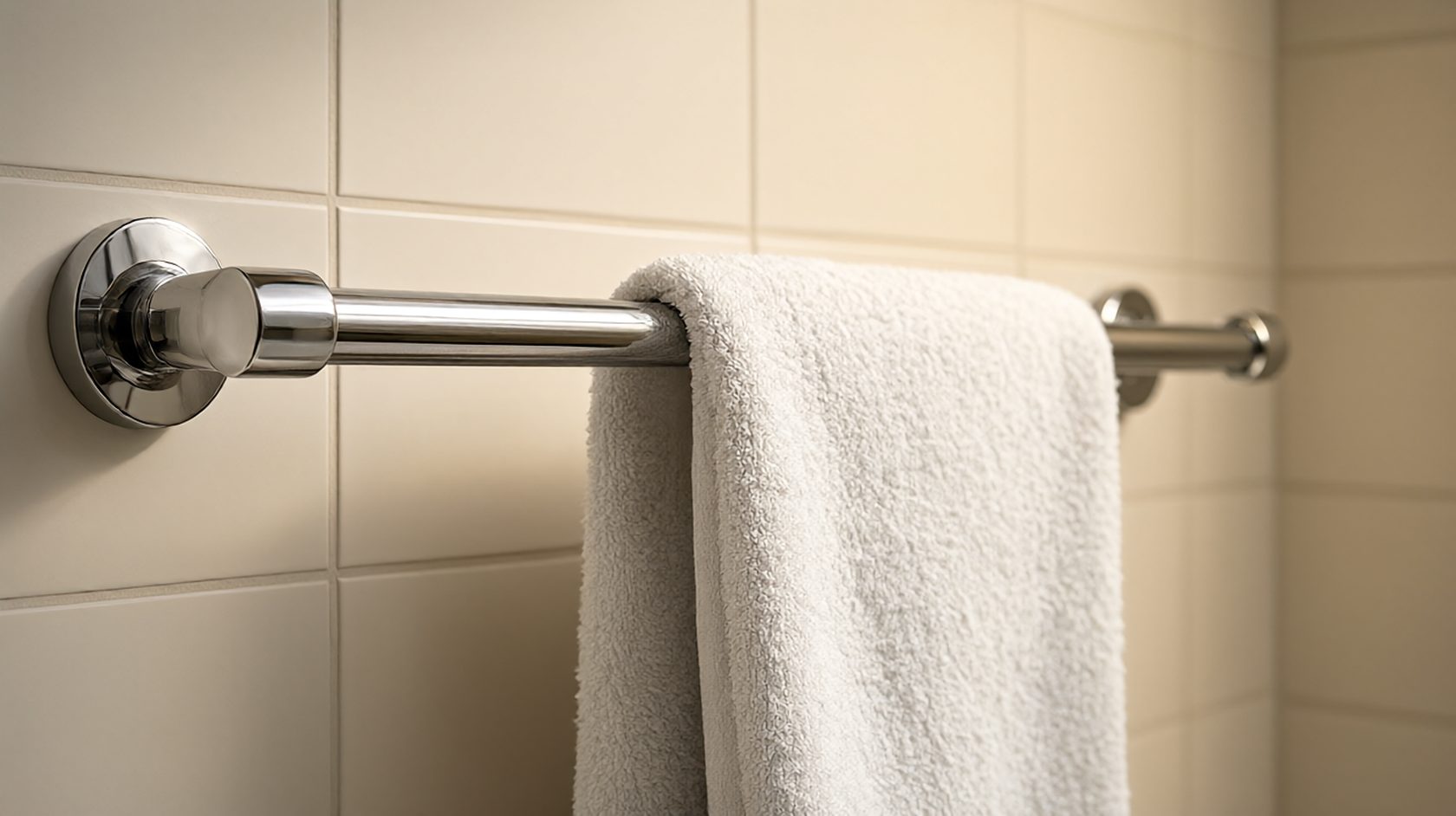
Two loads on one bracket
A towel bar carries a towel's weight downward; a handle carries a person's pull horizontally. A combined unit carries both, and the bracket is designed for the sum.
The sum is not simply additive: the towel's load is steady and the pull is transient, and the bracket's design should be governed by the transient.
The bracket's fixing pattern decides how the transient is distributed, and a bracket with two widely spaced bolts carries the pull as a couple rather than as a point load.
A combined unit that reuses a towel bar's bracket without widening the fixing pattern is a unit that will loosen at the first hard pull.
The wall behind the tile
The wall's substrate decides the fixing's capacity. A cement board with a stud behind it takes a bolt; plasterboard with a cavity takes almost nothing without a specialist anchor.
A tile is a brittle layer on top of the substrate, and a fixing that bears on the tile concentrates the load in the tile rather than in the wall.
The fixing should reach the substrate, and the tile should be drilled to the anchor's clearance rather than to the bolt's diameter.
A unit installed into tile alone is a unit that cracks the tile before it loosens, and the crack is the warranty claim.
Tube diameter and the hand's grip
A towel bar's tube diameter is chosen for the towel's drape and for the bracket's standard; a handle's diameter is chosen for the hand.
A combined unit often uses one tube size for both, and the size is a compromise between a towel bar's 19 or 22 mm and a handle's 25 mm.
The diameter should be stated with its wall, because a 25 mm tube with a thin wall bends under a pull, and a bent handle is a handle that feels broken.
A larger diameter is also a heavier section and a stronger bracket requirement, so the diameter and the fixing pattern should be chosen together.
Clearance, projection and the towel's path
The unit's projection from the wall decides whether a towel can hang without touching the wall, and a projection that is too small keeps the towel damp.
A combined unit's projection is usually set by the handle's clear width, and the towel bar sits further out than a plain bar would.
The clearance from a shower screen or a cabinet should be stated, because a handle that is close to a screen is a handle that traps fingers.
The installation drawing should show the projection, the fixing centres and the clearance as dimensions, not as a rendering.
Material, coating and the bathroom's chemistry
A bathroom's air is humid and often chlorinated, and the unit's material should be 304 stainless with a finish that survives both.
A brass unit with a chrome plate is a common specification, and the plate's thickness and its adhesion decide whether it pits in a year.
A coated aluminium unit is lighter and cheaper, and its coating is the part that fails, usually at the fixing where the bolts are tightened.
The specification should give the salt-spray hours and the coating's adhesion test, and both should match the environment the product is sold into.
The anchor, the bolt and the torque
The anchor's type should be chosen from the substrate: a chemical anchor in concrete, a stud anchor in timber, a cavity anchor in plasterboard.
The bolt's length must be long enough to engage the anchor fully and short enough not to bottom out, and the two are not the same number.
The torque should be specified, because a bolt that is too tight crushes the anchor's fixing and a bolt that is too loose lets the unit move.
A unit shipped without an anchor specification leaves the choice to the installer, and the installer will choose what is in the van.
Combinations that should not be sold together
A towel bar combined with a handle at a fixing spacing that suits neither is a product that fails both jobs.
A unit whose projection is set by the towel bar will put the handle too close to the wall for a hand, and a unit whose projection is set by the handle will put the towel too far out.
The combination should be designed around one of the two functions and sized so that the other is still usable, and the catalogue should say which one governs.
A buyer should test the combination's geometry with a towel and a hand before the specification is fixed, and a drawing will not answer that question.
The datasheet and the installation sheet
The datasheet should state the tube diameter and wall, the material and finish, the fixing centres, the projection and the weight limit.
The installation sheet should state the substrate requirements, the anchor type, the bolt and the torque, and the clearance dimensions.
The two documents together are what the specifier and the installer need, and a product shipped with one of them is a product that will be installed by guesswork.
A brand that publishes both is a brand whose return rate on this category is lower than its competitors'.
The template, the tile's joint and the drill's wander
A tile's joint is a weak line, and a hole drilled on the joint cracks the tile more easily than a hole drilled in the tile's body.
The template should be positioned so that the fixings land away from the joints and from the tile's edges.
A drill without a centre punch wanders on a glazed surface, and a wandered hole puts the bracket out of position by enough to skew the unit.
The installation sheet should show the template and the drill sequence, and a tile bit and a centre punch are two tools that prevent most of the damage.
The set screw, the grub screw and the finish's scar
A unit that is held by a set screw under the bracket is a unit that cannot be removed without a scar on the finish.
A concealed fixing with a cover plate is the better detail, and the cover should be removable without a tool that marks the plate.
The set screw's torque should be specified, because an over-tightened screw dents the tube and a loose one lets the unit rotate.
A specification that names the fixing's concealment is a specification that decides how the product looks after its first service.
Three numbers for the tender
The tender needs the fixing centres, the projection and the rated pull, with the substrate the rating assumes.
A combination rated on a stud wall and installed on plasterboard is a unit whose rating does not apply, and the substrate is part of the number.
A projection figure that is given without the clearance to a screen is a figure that will be resolved on site, usually badly.
The three numbers, each with its condition, are what turns a catalogue item into a specification item.
A brand that publishes them is a brand whose product can be installed without a site visit by the technical team.
Installation check in five minutes
Check the substrate behind each fixing with a probe or the builder's drawings, and confirm the anchor matches the substrate.
Then set the unit's level, tighten to the stated torque, and pull the handle once to confirm the bracket does not move.
A unit that is level and tight at installation stays level, because the movement that loosens it is the movement the check removes.
Closing note
The combination is a bracket with two jobs, and the job that decides the fixing pattern is the pull rather than the towel.
Specify the substrate, the anchor and the torque together, and the unit will still be tight after a year of daily use.
A combination that is rated on stud and installed on plasterboard is a rating that never applied, and the substrate line on the drawing prevents it.
A combination whose fixing pattern is wider than a plain towel bar's is the towel bar and handle combination, and the pattern is what the pull actually tests.
What to check
- Fixing centres and bracket fixing pattern
- Substrate requirement and anchor type
- Tube diameter and wall thickness
- Projection and clearance dimensions
- Material, finish and salt-spray hours
- Bolt length and tightening torque
- Which function governs the combination's geometry