Fitting detail · 20 Nov 2026
Glass shelf clamps: the bolt's shear, the shelf's edge and the load you can put on it
A shelf clamp looks like a small bracket. It is a cantilever fixing, and the glass it holds is a plate that fails at its edge.
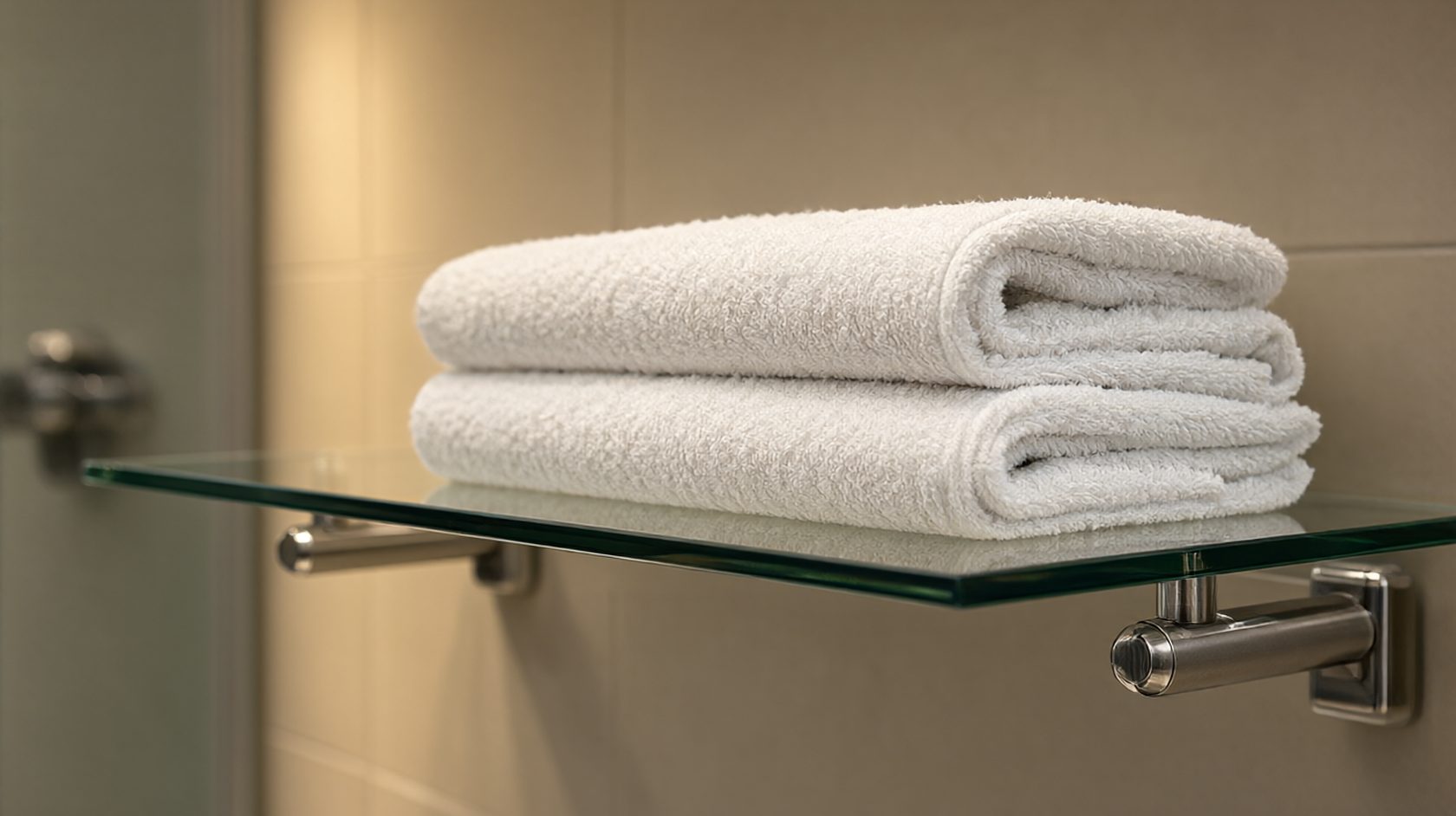
The clamp as a cantilever
A shelf clamp holds the glass at its edge and transfers the shelf's load to the wall as a moment, which the clamp's body and its fixing must resist.
The moment is the load times the shelf's projection from the wall, and a shelf that projects 300 mm puts three times the moment of one that projects 100 mm.
The clamp's body is short, so the moment is carried as a couple between the clamp's upper and lower contact points on the glass.
A clamp with a single contact point is a clamp that relies on friction to resist the moment, and friction is lost when the glass is wet or dusty.
The shelf's edge and the clamping zone
The glass shelf's edge sits in the clamp's slot, and the slot's depth should be at least a few times the glass's thickness to spread the contact stress.
A shelf that is clamped by only a few millimetres at each end is a shelf that will crack at the clamp, because the glass's edge is its weakest region.
The clamp's gasket protects the glass's edge, and a missing gasket is a metal-to-glass contact that starts a crack.
The specification should give the minimum clamp depth and the gasket's thickness, and the two together decide the shelf's safe load.
Load capacity and the two-clamp rule
A shelf on two clamps is a simply supported beam, and its capacity is set by the glass's thickness and the span between the clamps.
A shelf on three clamps is statically indeterminate, and the middle clamp takes a share that depends on how level the three are.
The catalogue's load limit should be per pair of clamps at a stated span and glass thickness, not a single figure.
A shelf that is loaded at its centre with a heavy item is a shelf whose mid-span deflection is the visible symptom, and glass's deflection is larger than a metal shelf's at the same load.
Glass thickness, tempering and the shelf's span
A 6 mm annealed shelf spans about 600 mm between clamps; an 8 mm toughened shelf spans further, and the difference is the glass's strength rather than the clamp's.
Toughened glass is stronger in bending and fails catastrophically rather than cracking, which is why it is preferred for a shelf over a bath.
The shelf's edges should be polished, because a rough edge is a crack initiation site under the clamp's contact stress.
The specification should give the maximum span for each thickness, and a shelf that exceeds it will sag visibly before it breaks.
The wall fixing and the anchor's shear
The clamp's fixing carries the shelf's load in shear and the moment in tension, so the anchor must be rated for both.
A fixing into a stud is stronger than a fixing into plasterboard, and a shelf clamp's small base plate concentrates the load on a small area.
The anchor's pull-out capacity should be checked against the moment's tension component, which is the load times the projection divided by the anchor spacing.
A clamp with a single anchor is a clamp that rotates about the anchor, and the shelf follows the rotation.
Corrosion, cleaning and the bathroom's chemistry
A shelf clamp in a bathroom sees water, soap and cleaning agents, and a zinc-plated clamp will corrode at the fixing.
A 304 stainless clamp is the default; a coastal or a pool-side installation needs 316.
The clamp's finish should resist the cleaning agents the household actually uses, and an acid cleaner will attack a plated finish.
The specification should state the material and the finish, and should warn against acid cleaners in the installation sheet.
Adjustment, levelling and the shelf's removal
A shelf clamp should allow the shelf to be levelled after installation, and the adjustment should not rely on loosening the wall fixing.
The clamp's design should let the shelf be lifted out for cleaning without removing the clamp from the wall.
A clamp that requires the wall fixing to be undone for cleaning is a clamp that will be left loose after the first clean.
The installation sheet should show the removal procedure and the re-tightening torque, and the two are what keep the shelf safe after a year of cleaning.
What the datasheet should say
It should state the glass thickness range, the clamp depth, the maximum span per thickness, the load limit per pair and the material and finish.
It should also state the anchor requirement, the adjustment range and the removal procedure.
Those items are what a specifier needs to size a shelf and what an installer needs to fit one, and a datasheet that omits the span leaves the sizing to the shop.
A shelf that is sized from a datasheet is a shelf that does not sag, and the datasheet is cheaper than the replacement.
The shelf's contents and the point load case
A shelf's load case is usually a uniformly distributed load, and a heavy bottle placed in the middle is a point load that the distributed figure does not describe.
Glass is weak under a point load because the contact area is small and the stress concentrates under it.
The specification should give a point load limit as well as a distributed one, and the point limit is usually a fraction of the distributed.
A shelf loaded with a heavy item at its centre is the case that sags visibly, and the datasheet should describe it.
The clamp's rotation and the shelf's alignment
A clamp that is fixed to a wall that is out of plumb will hold the shelf out of level, and the shelf's contents will slide.
The clamp's adjustment should correct a small error in the wall without loosening the anchor, and the adjustment range should be stated.
Two clamps on the same shelf should be set from the shelf rather than from the wall, so that the shelf is level even when the wall is not.
The installation sheet should describe that sequence, because the reverse sequence produces a shelf that is level in one axis and not the other.
Three numbers for the tender
The tender needs the maximum span per glass thickness, the load limit per pair with its point-load counterpart, and the clamp depth.
A span without the thickness is a span that assumes the thicker glass, and the thinner glass will sag before it breaks.
The point load is the number that describes a bottle in the middle of a shelf, and it is usually the number that is missing.
The clamp depth is the number that decides whether the shelf's edge cracks, and it belongs in the same table.
A datasheet with those four figures is a datasheet that a kitchen designer can use without calling the supplier.
A supplier who publishes them has sold the same shelf a thousand times and knows where it fails.
Installation check in five minutes
Check the two clamps' level against each other, the shelf's span against the datasheet, and the gasket's presence on each contact face.
Then load the shelf at its centre with the intended contents and look for deflection that does not recover when the load is removed.
A shelf that springs back is a shelf that is within its span; one that does not has been specified beyond it.
Closing note
A shelf clamp is a cantilever with a short lever, and the glass it holds fails at the edge long before it fails at the centre.
Publish the span, the point load and the clamp depth, and the shelf will be sized by the datasheet rather than by the showroom.
A clamp depth that is stated in millimetres is a shelf edge that does not crack, and the millimetres are free at the design stage.
The clamp whose maximum span and load limit are published is the glass shelf clamp, and the span is the number that decides whether the shelf sags.
What to check
- Clamp depth and gasket thickness
- Maximum span per glass thickness
- Load limit per pair of clamps
- Material and finish matched to environment
- Anchor type, shear and pull-out capacity
- Levelling adjustment independent of wall fixing
- Shelf removal procedure and re-torque value