Fitting detail · 20 Nov 2026
Glass door handles: the load path, the hole spacing and the pull that loosens them
A handle is a lever attached to a pane of glass through two holes. The pane is the weak part, and the hole spacing decides where it breaks.
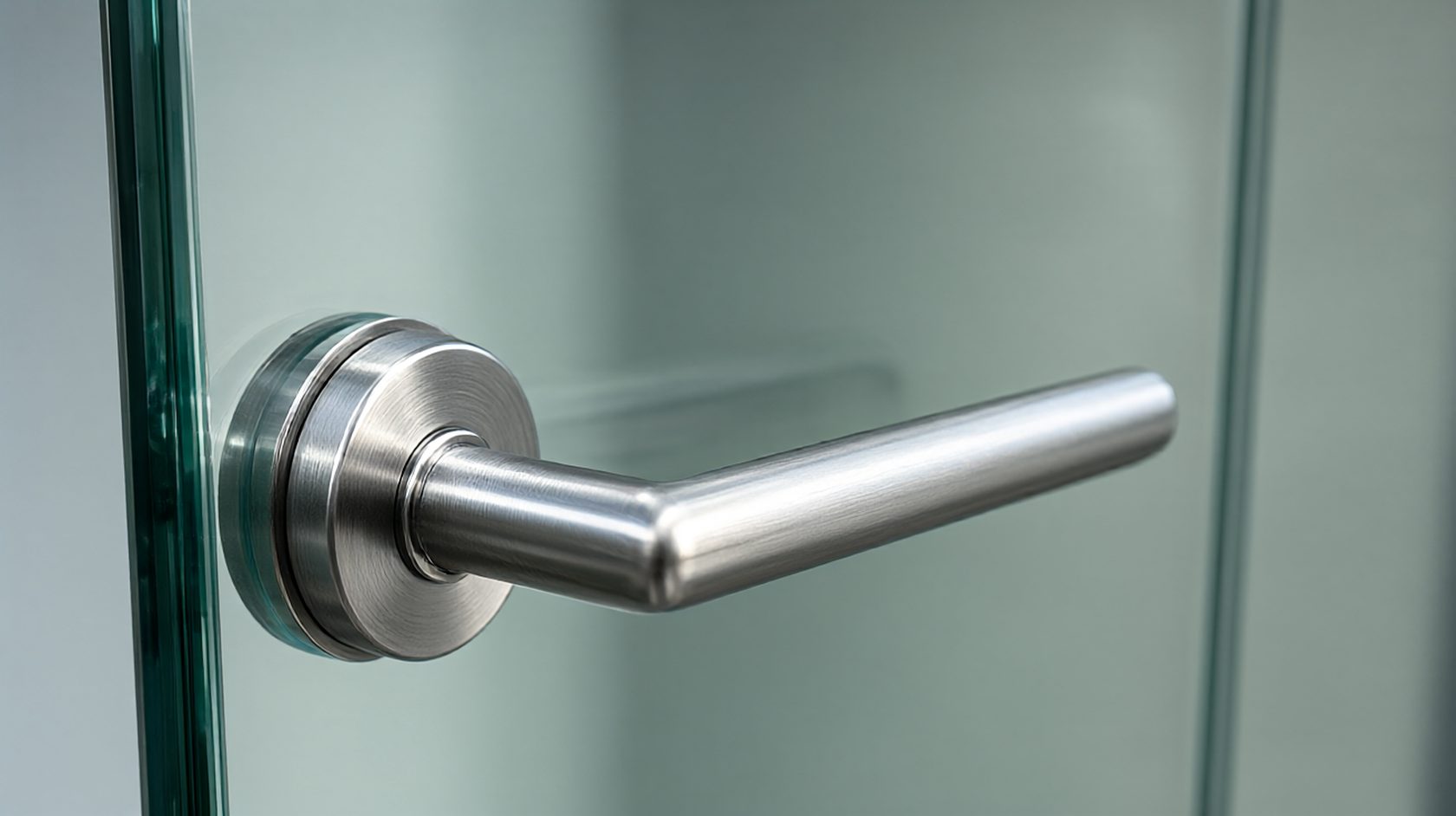
The handle as a lever
A door handle is a lever with the door's weight as its load. When a person pulls the handle, the force is applied at the handle's axis and resisted at the two fixing points.
The resistance is a couple: one point pushes, the other pulls, and the distance between them is the lever arm that reduces the load per point.
A handle with widely spaced fixing points loads the glass less than one with narrow spacing, at the same pull, because the couple's arm is longer.
This is why the hole spacing is a structural parameter and not a styling choice, and why a handle designed for a 10 mm pane should not be fitted to a 6 mm one.
Holes in tempered glass
Tempered glass is stronger than annealed glass everywhere except at its edges and at any hole that has been drilled into it.
The tempering process leaves the surface in compression and the interior in tension, and a hole interrupts that balance and concentrates stress at the hole's rim.
The hole's edge should be chamfered or polished, and the hole's diameter should exceed the fixing bolt by enough for a bushing, because the bushing spreads the load and absorbs the door's movement.
A hole drilled too close to the edge, or drilled after tempering, is a hole that becomes the origin of a crack that runs across the pane.
The bushing and the rubber washer
A handle's fixing has three parts: the bolt, a bushing that centres it in the hole, and a washer or gasket that bears on the glass.
The bushing's material matters. A hard nylon bushing transmits shock to the glass; a softer elastomer deforms and absorbs it.
The washer's area matters more than its thickness. A washer that concentrates the bolt's load on a small area produces a stress point at the hole's rim.
A handle sold without bushings is a handle that relies on the bolt's fit, and a bolt that fits loosely in a hole is a bolt that hammers the glass every time the door is used.
Pull force, door weight and the hinge's share
A framed glass door carries most of its weight on its hinges, and the handle only carries the pull. A frameless door on two patch fittings is a different problem.
The pull force is usually modest, but it is applied repeatedly, and the repetition matters more than the magnitude for a fixing that is slightly loose.
The handle should be mounted at a height that lets the user pull horizontally rather than downward, because a downward pull adds the door's weight to the handle's load.
The handle's length is a trade: a longer handle gives a longer lever for the user and a larger couple at the fixings, which is why long handles use wider spacing.
Material, finish and the salt-spray question
A 304 stainless handle is adequate indoors and marginal in a coastal or chlorinated environment; a 316 grade is the specification for those.
The finish decides the maintenance: a brushed finish hides fingerprints and a polished one shows them, and a mirror finish shows every scratch.
The salt-spray test's hours should be stated on the specification, because a handle that pits in a year is a handle the brand will replace under warranty.
A coated handle needs the coating's adhesion tested, not only its colour, because a coating that lifts at the fixing is the first place corrosion starts.
Back-to-back and the hollow section
A back-to-back handle has a fixing on each side of the door and a spindle or a pair of bolts that connect them. It is the standard detail for a frameless glass door.
The spindle's length must match the door's thickness plus the two fixings, and a spindle that is too long leaves the handle loose however hard the bolts are tightened.
The load path in a back-to-back pair is shared between the two sides, which is why it is stronger than a single-side handle at the same spacing.
A back-to-back handle on a hollow-section door needs a sleeve inside the section, or the section crushes as the bolts are tightened.
The template and the second hole
The holes are drilled before tempering, from a template that matches the handle's fixing centres. A template that is a millimetre out is a handle that will not fit.
The two holes should be drilled in one setup, with the glass supported, because a second setup can shift the spacing and the handle will bind.
The specification should give the hole diameter, the spacing, the edge distance and the bushing's part number, so that the glazier and the handle supplier are working from one document.
A hole that is drilled after tempering is a hole that voids the tempering guarantee, however carefully it is drilled.
What a handle specification should say
It should name the material grade, the finish and the salt-spray hours, the fixing centres, the hole diameter and the bushing, the glass thickness range and the door weight limit.
It should also state whether the handle is single-sided or back-to-back, and the spindle length range for each door thickness.
Those numbers are the difference between a handle that lasts the building's life and a handle that is replaced in the first year under a warranty claim.
A specification without the fixing centres is a specification that the glazier will resolve by guessing, and the guess will be on the brand's account.
The door's swing and the handle's arc
A handle's position relative to the door's hinge decides its arc: a handle close to the hinge travels a short distance with a high force, and one at the free edge travels far with a light force.
A handle mounted at the free edge is the standard, and the pull's direction should be perpendicular to the door rather than parallel to it.
A handle mounted too close to the hinge encourages a user to push the door rather than pull the handle, and the push loads the glass's edge rather than the fixing.
The specification should give the recommended mounting height and the distance from the leading edge, because the handle's position is part of its load case.
Maintenance, loosening and the re-torque cycle
A handle's fixings loosen over time because the glass and the fixing expand and contract at different rates, and the bolt loses preload with each cycle.
The loosening shows as a handle that rotates slightly, then as a handle that rattles, and then as a hole that has been hammered by the bolt.
The installation sheet should give a re-torque interval for doors in heavy use, and the interval should be shorter for a public building than for a home.
A maintenance schedule that includes the handle's torque is cheaper than the pane replacement that follows a loosened fixing.
Three numbers for the tender
The tender document needs three numbers from the handle's datasheet: the fixing centres, the glass thickness range and the rated pull.
A handle without a rated pull cannot be compared with another, and the comparison then falls back to the finish, which is not a performance attribute.
The rated pull should be given at a stated glass thickness, because the same handle on a thinner pane has a different capacity.
A specification that asks for those three numbers is a specification that excludes the products which cannot answer.
Installation check in five minutes
Check the two holes' spacing against the template, the bushing's fit in each hole, and the washer's contact area before the handle is offered up.
Then tighten to the stated torque and pull the handle at the free edge; a handle that moves is a handle whose fixings need a second look.
Five minutes at the first door saves the call-back at the tenth.
The handle whose fixing centres and bushing set are published is the stainless glass door handle, and those two numbers are what the hole spacing has to match.
What to check
- Material grade and salt-spray hours stated
- Fixing centres, hole diameter and bushing part number
- Glass thickness range and door weight limit
- Single-sided or back-to-back, with spindle lengths
- Washer area and bushing hardness specified
- Hole edge distance and drilling before tempering