Fitting detail · 20 Nov 2026
Glass clamps: clamping force, body thickness and the corner they hold
A clamp holds glass by friction and by the plate that bears on it. The numbers that matter are the glass thickness, the body's depth and the torque on the cap.
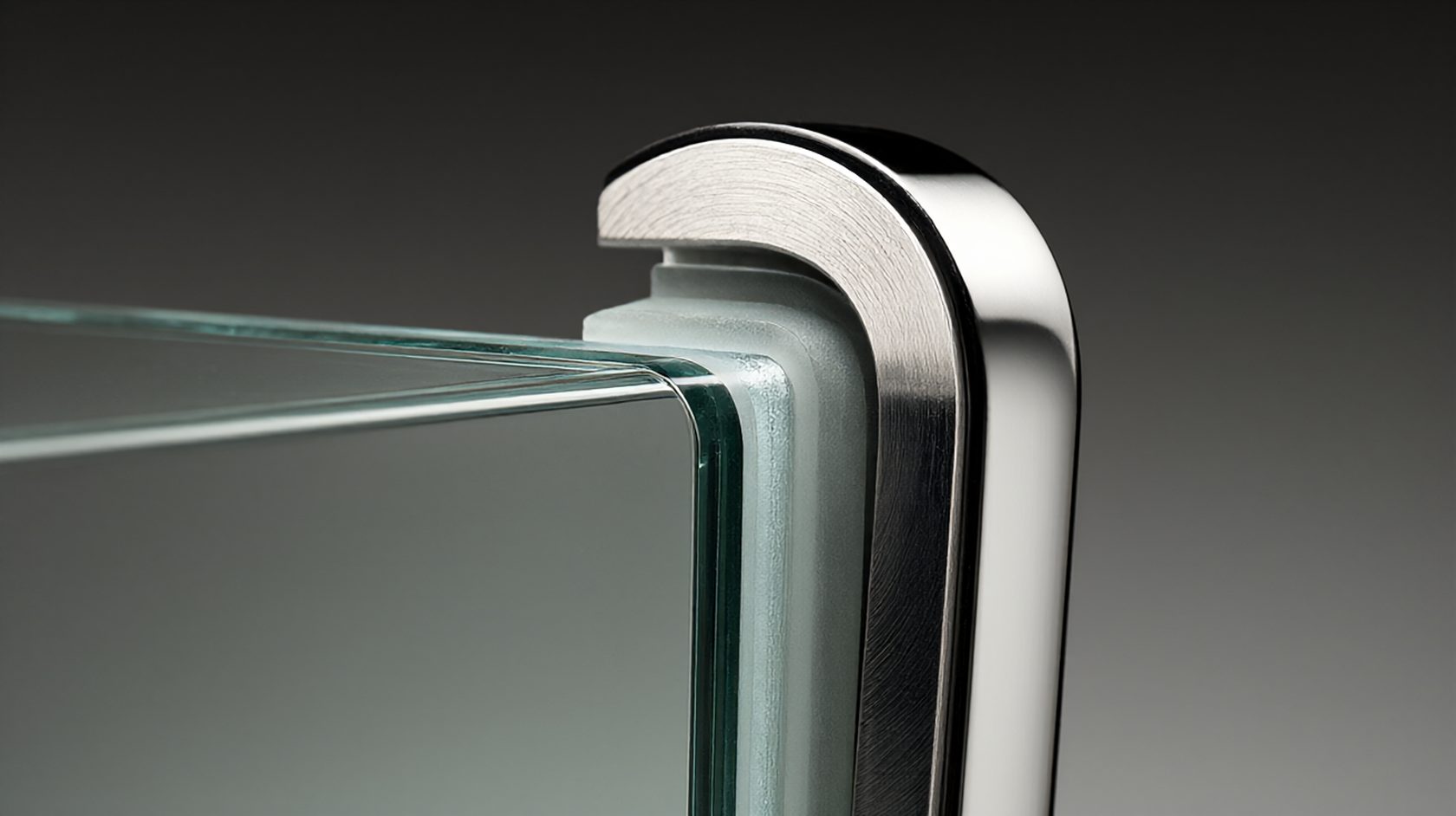
What a clamp actually provides
A glass clamp holds a pane by squeezing it between two plates, and the joint's strength is friction plus the mechanical restraint of the plates' edges.
The friction depends on the normal force, which depends on the cap's torque, and on the surfaces' condition, which depends on the gasket and the glass's cleanliness.
The plates' edges provide a mechanical stop that prevents rotation, and that stop is what carries the load when the friction is lost to age or to a loose cap.
A clamp that relies on friction alone is a clamp that fails progressively, and the failure shows as a pane that rotates rather than a pane that falls.
Glass thickness and the slot
The clamp's slot is sized to the glass's thickness plus the gaskets, and a slot that is too wide lets the pane rotate inside it.
A clamp specified for 8 mm glass used on 6 mm glass is a clamp whose cap bottoms out before it develops any force on the pane.
The slot's width should be stated with the gasket's material and thickness, because a 4 mm gasket compresses differently from a 3 mm one.
The specification should give the glass thickness range per clamp body, and the range is usually 6 to 12 mm in three or four discrete bodies.
The cap, the torque and the tool
The cap's torque is the single setting that decides the joint, and it should be specified in newton-metres rather than described as hand-tight.
A torque that is too low leaves the pane loose; too high crushes the gasket and can chip the glass at the slot's edge.
The cap should be tightened with a torque wrench or a driver with a clutch, and the installation sheet should say so with the value.
A clamp shipped without a torque value leaves the joint to the installer's wrist, and two installers will produce two different joints.
Corner clamps and the geometry of a 90-degree joint
A corner clamp holds two panes at a right angle, and the joint's strength depends on the clamp's body and the distance between its two slots.
The corner is the point where the two panes' movements add, so a corner clamp sees more stress than a wall clamp at the same torque.
The clamp's body should be deep enough that the pane's edge sits fully in the slot, and a pane that overhangs the slot is a pane that loads the gasket's edge.
A 90-degree joint with a single corner clamp is a hinge unless the seal or a second clamp restraints the rotation, and the specification should say which.
The gasket's material and the load it carries
A gasket is a compressible layer that distributes the cap's force and protects the glass's surface from the clamp's metal.
A hard gasket transmits shock to the glass; a soft one deforms and can extrude out of the slot under load.
The gasket's hardness should be stated in shore A, and it should match the glass's thickness and the clamp's slot.
A gasket that is missing or substituted is the most common cause of a clamp that slips, and the specification should name it as a part.
Load direction and the wall fixing
A clamp transfers the pane's load to the wall through its back plate and its fixing, and the fixing's pattern decides how the load is spread.
A wall clamp on a ceiling or a soffit sees a load in a different direction from a wall clamp on a vertical wall, and the fixing should be designed for the direction.
A clamp that carries a cantilevered pane should be specified with a maximum pane size, because the cantilever's moment grows with the square of the pane's height.
The wall fixing's anchors should be chosen for the substrate, and the clamp's back plate should be large enough to spread the moment across at least two anchors.
Testing the joint before the building opens
The joint should be tested by loading the pane at its free edge with a defined force and checking the pane's rotation at the clamp.
A joint that rotates under a small force is a joint that will rotate more under a person leaning on it, and the test is cheap compared with the consequence.
The test should be repeated after a few thermal cycles, because the gasket relaxes and the cap's torque falls as the gasket creeps.
The specification should state a re-torque interval for outdoor installations, where the thermal cycle is daily.
What the datasheet should carry
It should list the glass thickness range, the slot's width with the gasket, the cap's torque, the material and finish, and the maximum pane size.
It should also name the gasket as a part with its hardness, and state the re-torque interval.
Those five items are what the installer and the inspector need, and a clamp datasheet without the torque is a datasheet that describes a shape rather than a joint.
A brand that publishes them is a brand whose clamps can be specified, and specification is what turns a component into a system.
Clamps on a moving door and the fatigue question
A clamp on a door sees the door's weight and its swing, and the joint's load reverses every time the door moves.
A reversing load is a fatigue load, and a joint that is adequate under a static test can loosen under ten thousand cycles.
The clamp's cap should be checked after a defined number of cycles, and the specification should give the re-torque interval for a door in heavy use.
A clamp that is specified for a fixed pane and used on a door is a clamp whose torque schedule has been left out of the datasheet.
Glass edge quality and the clamp's bite
A clamp bears on the glass's edge as well as its faces, and an edge that has been polished holds better than one that has been cut and left rough.
A rough edge has micro-cracks that grow under the clamp's contact stress, and the failure starts at the edge rather than in the pane's centre.
The specification should require a polished or a seamed edge wherever a clamp is used, and the glazier's order should say so.
An edge that is acceptable for a framed installation is not acceptable for a clamp, and the two specs are often confused.
Three numbers for the tender
The tender needs the glass thickness range, the cap torque and the maximum pane size, with the gasket named as a part.
A clamp quoted without torque is a clamp whose joint depends on the installer, and two buildings will behave differently with the same product.
The maximum pane size is the number that prevents a cantilevered pane from being specified beyond the clamp's capacity, and it is usually the number missing.
Those three numbers plus the gasket's hardness are the whole specification of a clamp, and the rest is finish.
A supplier who can produce them has tested the joint; one who cannot has photographed it.
Installation check in five minutes
Check the gasket is present on both faces, the pane sits fully in the slot, and the cap reaches the stated torque.
Then load the pane's free edge by hand and watch the clamp for rotation; a clamp that rotates needs a second pass at the torque.
Record the torque and the date, because the re-torque interval starts from that entry.
Closing note
A clamp is a joint, and a joint is defined by the torque that creates it rather than by the shape of the body.
Publish the torque, name the gasket, and the clamp stops being a decorative fitting and becomes a specifyable component.
A torque that is written on the installation sheet is a torque that two installers will apply the same way.
The clamp whose cap torque is specified is the glass-to-glass sleeve clamp, and the torque is the difference between a joint and a shape.
What to check
- Glass thickness range per clamp body
- Slot width and gasket material/hardness
- Cap tightening torque in Nm
- Maximum pane size for cantilevered loads
- Back plate size and anchor count
- Re-torque interval for outdoor exposure
- Gasket listed as a purchasable part