Fitting detail · 20 Nov 2026
Double sliding door systems: track section, trolley load and the sag you cannot adjust
A sliding door runs on a track and hangs from trolleys. The track's section decides the load, the trolleys decide the smoothness, and the sag decides whether the door can be closed.
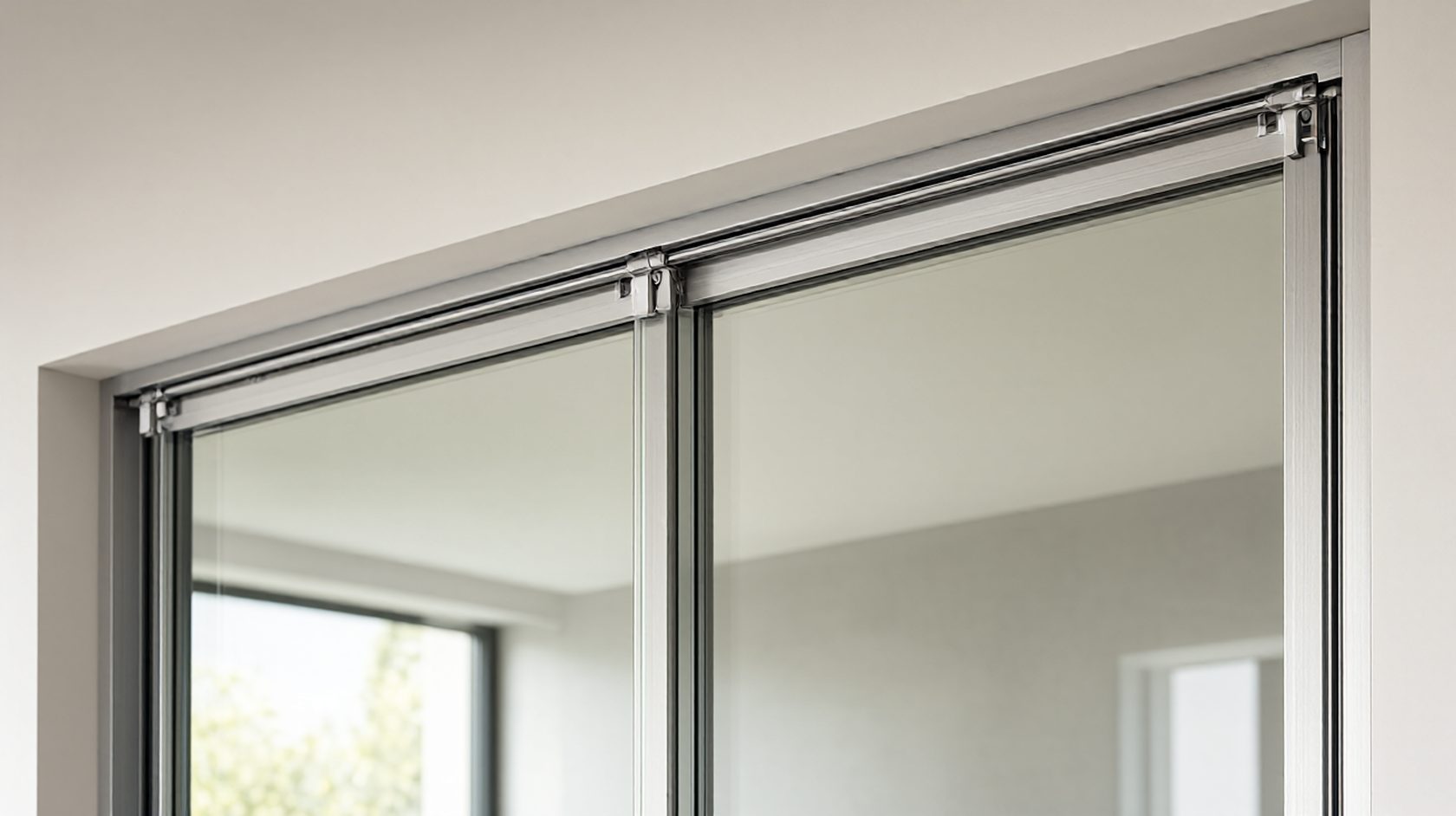
The track as a beam
A sliding track is a beam that carries the door's weight plus the dynamic load of every start and stop, and it deflects under that load.
The deflection is a function of the span, the section's moment of inertia and the load. A track spanning three metres with a light section sags in the middle, and the door follows the sag.
A sagging track makes the door drift away from the frame at mid-span, which shows as a gap that opens and closes as the door moves.
The track's section should be chosen from the span and the door's weight, and the catalogue should give a maximum span per section rather than a single maximum weight.
Trolleys, wheels and the four-point rule
A door hangs from two or more trolleys, and each trolley carries two or four wheels. The number of wheels spreads the load but does not change the track's deflection.
The wheels' material decides the noise and the wear: a nylon wheel is quiet on an aluminium track and wears; a steel wheel lasts and transmits every irregularity as noise.
A trolley with a single wheel on a round track can rotate about the track, which lets the door twist. A trolley with a pair of wheels on a flat track resists the twist.
The trolley's height adjustment is the only way to level a door after installation, and it should be accessible without removing the door from the track.
Two leaves, one opening and the overlap
A double sliding system has two leaves that meet in the middle, and the leaves overlap at the meeting point to close the opening.
The overlap is usually a few centimetres, and it is the part of the system that decides whether the door is light-tight and draught-free.
The overlap must be maintained through the leaves' travel, which means the tracks are offset and the trolleys are positioned so that the overlap does not reduce as the door opens.
A system with no overlap relies on a seal, and a seal that is compressed by two moving leaves wears quickly and stops sealing.
Soft-close, the damper and the last centimetre
A soft-close mechanism is a damper that catches the door in the last few centimetres and pulls it shut at a controlled speed.
The damper's force should match the door's weight; too strong and the door is hard to open from rest, too weak and it does not complete the last centimetre.
The damper's position is set at installation and is not usually adjustable afterwards, so the door's weight must be known before the mechanism is selected.
A soft-close that is sold as an accessory for a track that was not designed for it is a mechanism that fights the trolley, and the symptom is a door that bounces at the end of its travel.
Alignment, plumb and the frame's tolerance
A sliding door's track must be level and the door must hang plumb. A track that is level but the door hangs out of plumb produces a door that drifts open.
The frame's tolerance matters: a frame that is out of square by a centimetre over two metres will show as a gap at one end of the door's travel.
The installer should set the track from the frame's highest point rather than its average, and should check the door's plumb at both ends of travel.
A door that is out of plumb by more than a few millimetres per metre will not stay closed without a latch, and a latch on a sliding door is a compromise.
The floor guide and the door's swing
A sliding door needs a floor guide to stop it swinging, and the guide's type depends on whether the door has a bottom rail.
A framed door with a bottom rail can use a simple guide that the rail passes over; a frameless glass door needs a guide that bears on the glass's edge without chipping it.
The guide's clearance should be set so that the door can move without rubbing, because a guide that rubs is a guide that scratches the glass or wears the rail's finish.
A door with no guide swings at the bottom, and the swing loads the trolleys in a direction they were not designed for.
Weight limits and the pair of leaves
The catalogue's weight limit is per leaf, not per system, and the two leaves together double the load on the frame's fixings rather than on a single trolley.
A double system's fixing points carry the sum of both leaves plus the dynamic load, and the wall or the frame must be able to take it.
The specification should give the maximum leaf weight, the maximum leaf width and the maximum total opening, and the three are related rather than independent.
A system that is within its leaf limit but at the edge of its opening limit will sag in the middle of the run, where the track's span is longest.
What to write on the specification
It should state the track section and its maximum span, the trolley's wheel count and material, the leaf weight and width limits, and the overlap.
It should also state the soft-close's compatibility, the floor guide's type, and the fixing method for the track's brackets.
Those items are what the installer needs and what the warranty will be judged against, and a specification that omits them is a specification that leaves the outcome to the site.
The best time to write it is before the frame is built, because the frame's tolerance is part of the system's performance.
The stop, the bumper and the door that hits the frame
A sliding door's travel is limited by a stop at each end, and the stop absorbs the door's kinetic energy every time it is opened or closed.
A rubber bumper is the cheap solution and it wears; a spring or a damper is the durable one and it needs to be sized to the door's mass.
A stop that is fixed to the track rather than to the frame is the better detail, because the track is designed for the load and the frame is not.
A door that hits a hard stop without a bumper transfers the impact to the trolleys and to the track's fixings, and the loosening starts there.
The reveal, the pocket and the wall's thickness
A double sliding system can run on the face of the wall or into a pocket, and the pocket version needs the wall to be deep enough for the leaves and the track.
A pocket that is too shallow leaves the door proud of the wall, and a door that is proud of the wall cannot be sealed at its edge.
The pocket's lining should be rigid enough that the track's brackets bear on structure rather than on plasterboard.
The specification should give the minimum wall thickness and the pocket's clear dimensions for each leaf size.
Three numbers for the tender
The tender needs the maximum leaf weight, the maximum leaf width and the maximum total opening, each at a stated track section.
A system quoted by its opening alone hides the leaf weight, and a heavy leaf on a light track is the failure the number would have prevented.
The three numbers interact, and a supplier who gives only one of them is a supplier who has not tested the combination.
Installation check in five minutes
Check the track's level along its length, the door's plumb at both ends of travel, and the meeting leaves' overlap with the door closed.
Then open and close the door three times and watch the trolleys at the stop; a trolley that jumps is a track that is twisted.
The three checks are dimensional, and none of them needs a load test.
A system that states its maximum span per track section is the double sliding door system, and that number is the one the opening has to be checked against.
What to check
- Track section and maximum span per section
- Trolley wheel count and material
- Leaf weight and width limits, and total opening
- Meeting overlap maintained through travel
- Soft-close compatibility and door weight
- Floor guide type matched to framed or frameless
- Track brackets and fixing method for the wall