Fitting detail · 20 Nov 2026
Brass and stainless tubing: wall thickness, temper and the joint that holds
A tube is specified by its outside diameter, and its performance is set by a wall thickness nobody prints on the label.
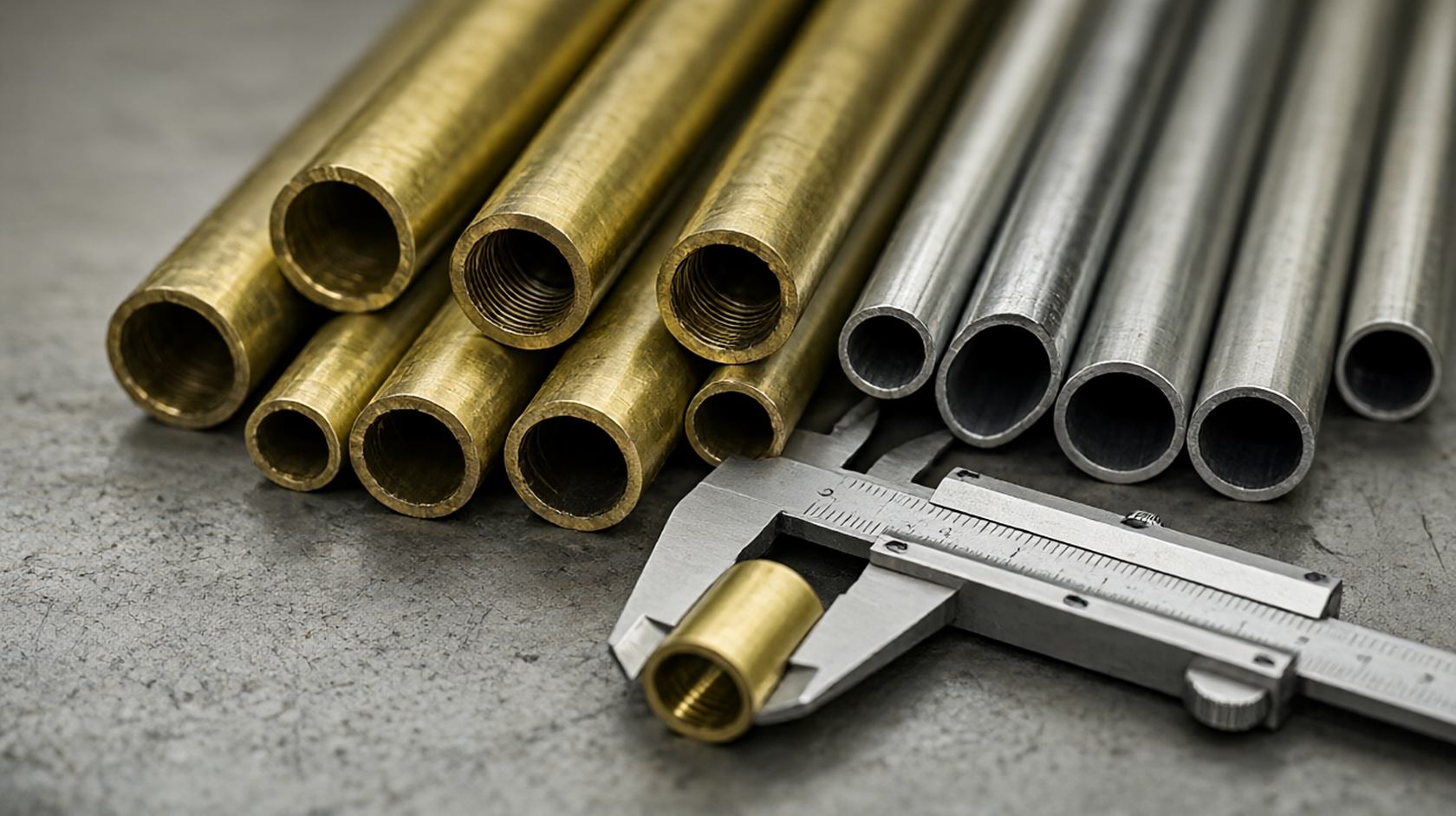
Outside diameter is a fitting dimension, not a strength
A tube's outside diameter is chosen so that a fitting can be clamped to it, and a 19 mm tube is 19 mm outside whatever its wall is.
The wall thickness sets the tube's strength and its weight, and the two catalogue lines that look identical can differ by a third in wall.
A tube sold as 19 mm with a 1.0 mm wall and one with a 1.2 mm wall fit the same bracket and behave differently under a towel bar's load.
The specification should state both diameters and the wall's tolerance, because a wall that varies along the length is a joint that will not seal.
Temper, hardness and the bending radius
A tube is supplied annealed, half-hard or hard, and the temper decides how far it can be bent before it cracks.
A hard tube bends to a large radius and springs back; an annealed tube bends to a small radius and stays where it is bent.
A fabricator who bends a hard tube without annealing it produces a tube with a crescent crack at the bend's inner face, and the crack shows only after installation.
The specification should give the temper and the minimum bend radius, and the two belong together because the radius is a function of the temper.
Brass, lead and the drinking-water question
Brass is an alloy of copper and zinc with a small lead addition that improves machinability, and the lead content is regulated in products that touch drinking water.
A brass fitting sold into a market with a lead limit needs a declaration of the alloy's lead content, and a low-lead or lead-free brass is the specification that satisfies it.
The alloy's designation should be on the drawing, because 'brass' covers a range that includes alloys unsuitable for potable water.
A dezincification-resistant brass is the specification for a fitting that will see water with a high chloride content, and the difference shows as a fitting that fails from the inside.
Stainless grade, finish and the coastal case
A 304 stainless tube is the default indoor grade; a 316 grade is the specification where chlorides are present, including coastal air and swimming pools.
The finish matters as much as the grade: a brushed or a pickled surface resists corrosion better than a polished one with embedded iron from a contaminated tool.
A tube that is cut and welded should have the weld passivated, because the heat-affected zone loses its passive layer and becomes the first place to rust.
The salt-spray hours on the specification should match the environment the product is sold into, and a coastal product's hours should be materially higher.
Joints: compression, brazed and threaded
A compression joint seals on the tube's outside diameter with an olive or a rubber seal, and its reliability depends on the tube's surface and the fitting's torque.
A brazed joint is stronger and requires the tube to be clean and the heat to be controlled, because an overheated joint loses the tube's temper and corrodes.
A threaded joint needs the thread's standard, and a thread that is mismatched between the tube's fitting and the wall's fitting is a leak that no amount of tape will fix.
The joint's method should be stated on the specification because it decides the installation's labour and its failure mode.
Wall thickness and the threaded end
A tube that is threaded loses wall thickness at the thread, and a thin-wall tube that is threaded at both ends is a tube that is weakest exactly where it is joined.
The specification should give a minimum wall at the thread's root, not at the tube's plain section, because the root is where the load concentrates.
A tube that is too thin to thread should be joined with a compression fitting or a welded stub rather than with a thread.
A fabricator who threads a 1.0 mm wall to a standard thread produces a tube that splits at the first tightening, and the customer blames the fitting.
Straightness, ovality and the bracket that will not fit
A tube's straightness is usually specified as a maximum deviation over a length, and a tube outside that tolerance will not pass through a close-fitting bracket.
Ovality is the difference between the maximum and minimum diameter at a section, and it decides whether a compression olive seals.
The specification should state the straightness and the ovality in the same units as the diameter, because a supplier will otherwise quote the nominal and deliver the practical.
A tube that is straight and round is a tube that a bracket can be designed around, and a specification that omits both is a design that assumes a perfect tube.
The datasheet that a buyer can use
It should list the grade, the temper, the outside diameter and wall with tolerances, the straightness and ovality, the finish and the salt-spray hours.
It should also state the jointing methods that are compatible and the minimum wall at a thread, because those decide whether the tube can be used at all.
A tube's price per metre is not comparable across suppliers unless the wall is stated, and a buyer comparing on price alone is comparing two different products.
The datasheet's job is to make that comparison possible, and a datasheet that omits the wall is a datasheet that hides the difference.
Cutting, deburring and the fitting that will not seal
A tube is cut with a wheel or a saw, and both leave a burr on the inner edge that reduces the bore and scores the fitting's seal.
The burr should be removed before the fitting is offered, and the tube's end should be square to within a degree or two.
A tube that is cut with a hacksaw and left unsquare will seat on one side of the olive and leak on the other, and no amount of tightening will fix it.
The installation sheet should name the cutting method and the deburring tool, because those two decide the joint more than the fitting does.
Weight, handling and the long length's sag
A tube's weight per metre is a function of its wall, and a long length of thick-wall tube sags under its own weight when it is handled by two people.
A tube that is stored horizontally on a rack with insufficient supports takes a permanent set, and a bent tube cannot be straightened by the installer.
The specification should give the weight per metre and the maximum unsupported length for storage.
A supplier who ships a tube in a flimsy carton is shipping a tube that arrives bent, and the claim is on the freight rather than the mill.
Three numbers for the tender
The tender needs the wall thickness with its tolerance, the grade and the temper, and the finish with its salt-spray hours.
A tube quoted by diameter alone is a tube whose price is set by the thinnest wall the mill will roll, and the tender will not see the difference.
The three numbers make the tube comparable, and a mill that will not state them is a mill that is selling a section rather than a product.
A buyer who writes them into the order is a buyer who will receive what was specified, because the inspection can measure all three.
Installation check in five minutes
Check the cut's squareness, the burr's removal and the fitting's engagement mark before the joint is tightened.
Then pressure-test the joint where the installation allows, and record the result against the fitting's location.
A joint that is checked at installation is a joint that does not surprise the building in year two.
Closing note
Two tubes with the same diameter and a different wall are two products, and only one of them will hold the bracket the buyer has already ordered.
State the wall, the temper and the tolerance, then measure them on arrival; the rest of the datasheet follows from those three.
The tube whose wall and temper are on the datasheet is the brass square tubing, and a tube without those two figures cannot be compared with any other.
What to check
- Grade, temper and minimum bend radius
- Outside diameter and wall thickness with tolerances
- Straightness and ovality limits
- Finish and salt-spray hours matched to environment
- Jointing method stated (compression, brazed, threaded)
- Minimum wall at the thread root
- Lead content declaration for potable-water fittings